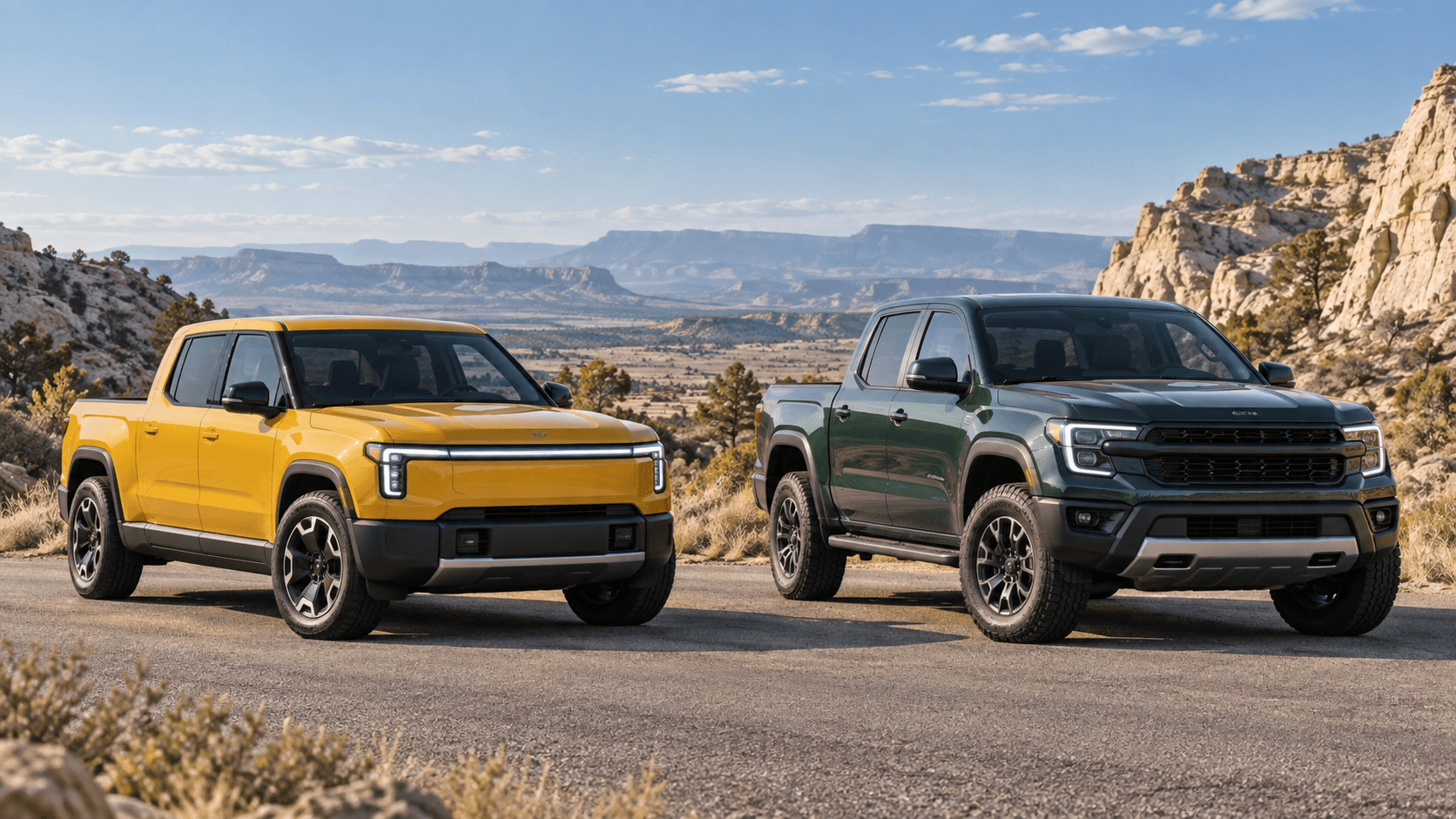
Wait for the Ford Fathom if you want an affordable electric daily driver with a pickup bed and you can reliably charge at home. Choose the Ford Ranger if towing, payload, 4x4 capability or long-distance flexibility is a requirement rather than a possibility.
That is our answer before the specifications turn into a wall of numbers. The Fathom and Ranger are both midsize Ford pickups with five-passenger cabins, but they are designed around different priorities. One tries to make an EV simple and affordable. The other is an established gasoline truck with published capability and inventory you can inspect today.
This comparison uses the 2026 Ranger currently presented on Ford's U.S. website and the Fathom information announced as of September 17, 2026. We have not driven the Fathom, and several specifications needed for a complete head-to-head test remain unavailable.
The Fathom starts $5,200 below the Ranger
Ford has announced a $28,350 starting MSRP for the standard-range Fathom. The destination and delivery charge adds $1,595, producing a starting figure of $29,945 before taxes, registration, dealer fees and options. Ford lists those amounts in the official Fathom FAQ.
The 2026 Ranger XL starts at $33,550 before destination and other charges on Ford's current model page. Comparing the base MSRPs before delivery creates a $5,200 advantage for the Fathom.
That does not establish a $5,200 real-world saving. The least expensive Fathom includes a standard-range battery and rear-wheel drive. A larger battery, AWD, additional equipment and home charging installation could narrow or erase the gap. Ranger buyers also need to account for 4x4, the Trailer Tow Package and any comfort or technology options they select.
Our team would compare written prices for configurations that perform the same job. A base electric commuter and a 4x4 Ranger prepared to tow are not equivalents simply because both have four doors and a bed.
Ford Fathom vs. Ranger specifications
| Category | 2026 Ford Ranger XL | Ford Fathom |
|---|---|---|
| Starting MSRP | $33,550 before destination | $28,350; $29,945 including announced destination |
| Availability | Current model; search dealer inventory | Preorders scheduled for early 2027 |
| Power source | 2.3L EcoBoost gasoline engine | Battery electric |
| Base drivetrain | 4x2; 4x4 available | Rear-wheel drive; AWD expected as an option |
| Driving range | Refuel at gasoline stations; range varies with use | EPA estimate not yet announced |
| Maximum towing | 7,500 lb when properly equipped | Not announced |
| Maximum payload | 1,767 lb | Not announced |
| Bed | 43.5 cu. ft.; dimensions published | Pickup bed confirmed; dimensions not announced |
| Passenger capacity | Five | Five adults |
| Power export | Available Pro Power Onboard, up to 400 W | Bidirectional power capability confirmed; details pending |
Ranger capability and configuration data: Ford's 2026 Ranger specifications. Fathom information: Ford's Fathom page. Maximum ratings require the correct configuration and equipment; always verify the label and documentation for the individual truck.
The Ranger wins every capability question Ford has answered
The Ranger is the straightforward choice when a truck already has a demanding job. Ford publishes a maximum available towing capacity of 7,500 pounds and a maximum available payload of 1,767 pounds. The Ranger XL, XLT and Lariat can reach the towing maximum when properly equipped with the available Trailer Tow Package. Individual payload varies with drivetrain, trim and equipment.
Ford has not announced a Fathom towing rating, payload rating or complete bed dimensions. That does not mean the electric truck will be incapable. It means there is no responsible way to promise that it can replace a Ranger for a specific trailer or load.
If you regularly tow more than a small utility trailer, we would plan around the Ranger until Ford publishes and independently demonstrates the Fathom's limits. The same applies to a contractor who knows the weight of tools and materials carried each day. A hoped-for specification is not a working payload label.
For off-road use, the Ranger is more than a specification sheet
The Ranger can be ordered with 4x4, an FX4 Off-Road Package and towing technology. Ford also offers the Ranger Raptor with a 3.0-liter EcoBoost V6, specialized FOX shocks, electronic-locking front and rear axles and 10.7 inches of ground clearance. Even the mainstream Ranger lineup gives buyers known hardware and several years of real-world owner experience.
The Fathom is expected to offer AWD, but Ford has not presented it as a Ranger Raptor alternative. We still need ground clearance, tire sizes, underbody protection, water-fording guidance, drive modes and recovery-point information. An electric powertrain can deliver excellent low-speed control; that does not automatically make the rest of the truck ready for a difficult trail.
Our view is simple: if your weekends genuinely include rough access roads, deep sand, rocks or remote campsites, buy against equipment you can verify. If “off-road” means a maintained gravel road to a trailhead, the Fathom may ultimately be more than sufficient.
The Fathom should be the better everyday commuter
The Fathom's strongest argument appears Monday through Friday. A household with home charging can begin most mornings with the energy needed for the day. There is no gas-station stop, no oil change and no transmission shifting through traffic. Ford is also targeting more passenger volume than a Toyota RAV4, which suggests the cabin is a priority rather than an afterthought.
The Ranger remains a practical five-seat truck, but it carries truck hardware even on days when the driver only needs a seat and a laptop bag. Its 2.3-liter EcoBoost engine, 10-speed automatic transmission and body-on-frame capability are advantages when they are used. In routine commuting, they also mean buying and fueling more traditional truck than some owners need.
We expect the Fathom to be quieter, smoother in stop-and-go traffic and cheaper to power for many drivers who charge at residential electricity rates. We cannot calculate a universal savings figure yet because Ford has not released Fathom efficiency, battery capacity or charging-loss data. Electricity and gasoline prices also vary widely.
Range and road trips could reverse the decision
The Ranger can be refueled quickly almost anywhere. That matters on long highway trips, while towing and in rural areas with limited charging infrastructure. Its trip length is not tied to an unannounced charging curve or the availability of a compatible fast charger.
Ford has not published the Fathom's EPA range, battery capacity, maximum DC charging rate or 10–80% time. Our current Fathom Mods forecast is approximately 200–230 EPA miles for the standard-range rear-wheel-drive version and 270–300 miles for a larger-battery version. Those figures are our estimates, not Ford specifications.
For daily travel, even the lower range could be enough. For a 600-mile day, a trailer trip or winter travel far from major highways, the unanswered charging questions become decisive. We would wait for independent highway-range and charging tests before choosing the Fathom as a frequent road-trip truck.
Fathom technology versus Ranger familiarity
Ford has confirmed several appealing Fathom features: a large touchscreen, standard Apple CarPlay and Android Auto compatibility, a Digital Key, Ford app remote controls, next-generation BlueCruise capability and built-in navigation powered by Apple Maps. The Universal EV Platform will also support EV routing and battery preconditioning.
The Fathom's bidirectional power capability could become a major advantage. The truck may be able to serve as a useful energy source at home, at a campsite or on a jobsite. Ford has not yet specified output, compatible equipment or whether full home backup will be supported, so we would not assign it a dollar value yet.
The Ranger offers less dramatic power export: available Pro Power Onboard supplies up to 400 watts through in-cab and in-bed outlets. That is not a home-backup system, but its capability is defined. This comparison captures the larger difference between the trucks: the Fathom carries more potential; the Ranger carries more confirmed answers.
Which truck should a family wait for?
Both trucks seat five, but passenger count alone cannot settle a family decision. We would bring the actual child seats, sit behind the intended driver position and check how easily everyone enters. We would also compare bed access, covered storage and the space needed for strollers, sports gear or luggage.
The Fathom's front trunk could be especially useful for clean, lockable storage separate from the bed. Its projected passenger volume is encouraging. The Ranger counters with a known 43.5-cubic-foot bed, under-seat rear storage and a vehicle families can inspect now.
For school, commuting and weekend home-improvement runs, the Fathom is the one we would wait to evaluate. For a family that tows a boat, travels long distances into areas with weak charging coverage or treats off-road access as part of the trip, the Ranger remains our safer recommendation.
Should you wait for the next Ranger?
The 2026 Ranger is already on sale, so most buyers are not waiting for Ford to prove the basic vehicle. They may be waiting for the desired configuration, a better offer or a future model-year update. That is different from waiting for the Fathom, whose final range, charging, towing and delivery timing are still unresolved.
If you want a Ranger, we would compare current inventory and pricing rather than postpone the purchase solely because the Fathom exists. The two trucks overlap in size, but a buyer who needs Ranger capability should not assume the less expensive EV will provide it.
If you do not need a truck until 2027, waiting has value even if you eventually choose the Ranger. The Fathom's complete order guide may clarify the choice, and a current Ranger will still offer the advantage of established specifications. Keep the decision reversible until Ford publishes the information that matters to your use.
What our team would choose
- Daily commuter with home charging: wait for the Fathom's final range, price and independent testing.
- Regular towing or known payload needs: choose a properly equipped Ranger.
- Frequent long-distance and rural travel: Ranger, unless the Fathom's larger-battery version and charging network prove convenient for the exact route.
- Light household use with an occasional bed requirement: the Fathom is the more interesting value proposition.
- Serious off-road plans: Ranger FX4 or Raptor, selected around the terrain and budget.
- No urgent purchase: wait until the Fathom order guide appears, then compare real configurations instead of headlines.
Our verdict: buy capability, wait for efficiency
The Ford Ranger is the truck we would choose for work already on the calendar. The Ford Fathom is the truck we would wait for when most miles are ordinary and the bed is valuable without being the center of the vehicle's job.
The Ranger justifies its higher starting price with published towing, payload and off-road equipment. The Fathom counters with a lower announced price, electric operation, a potentially roomier cabin and technology designed around daily convenience. It could be the smarter truck for many households - but only after Ford confirms the range, charging performance and capability of the version those households can actually buy.
Do not wait because one truck is newer. Wait only if its advantages match the way you will use it. For a commuter who can charge at home, that may be the Fathom. For a driver who needs a truck to behave like a truck every week, the Ranger has already answered the important questions.