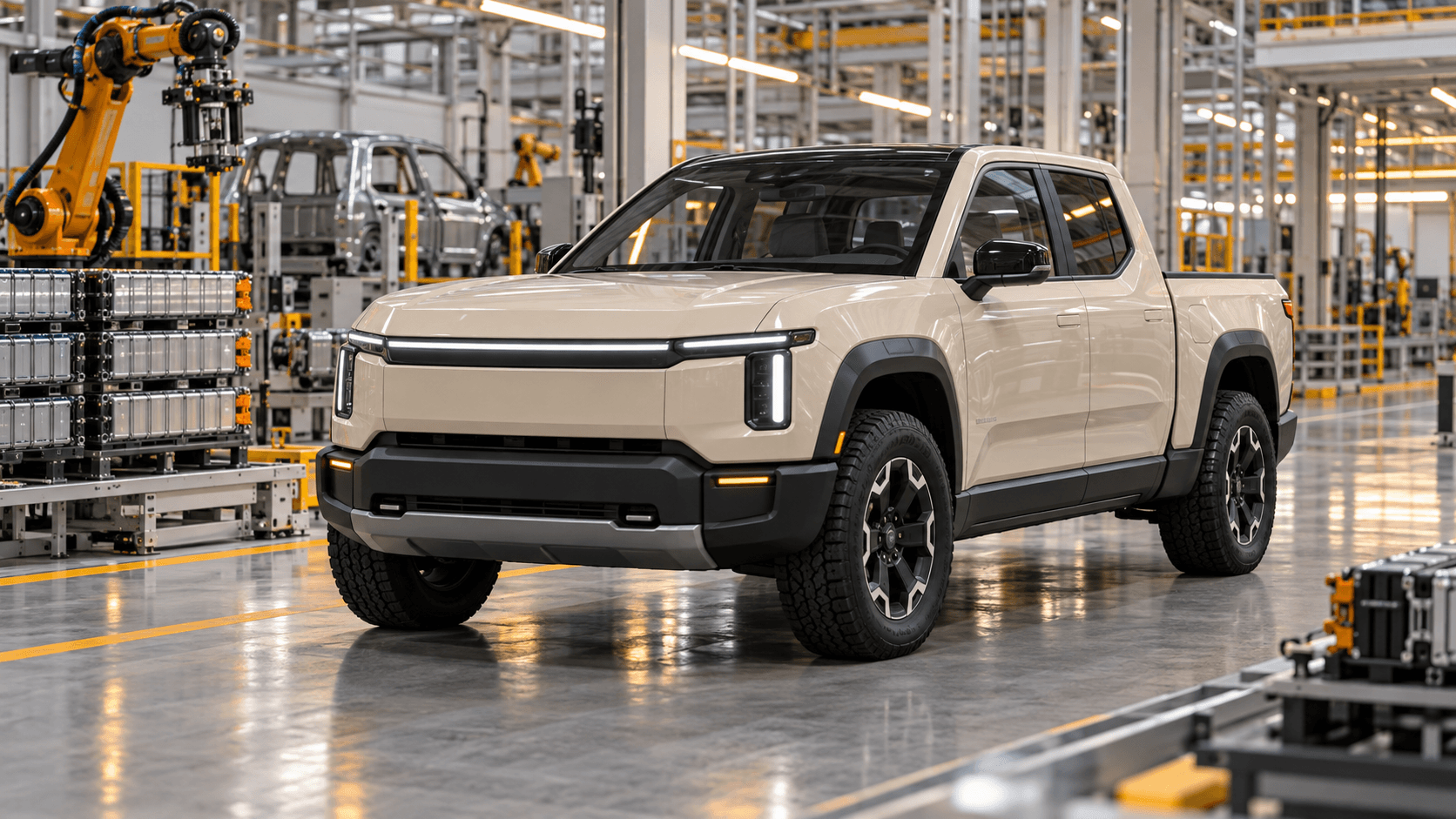
A $29,945 electric Ford pickup should be an easy headline. After the reversal of Ford's F-150 Lightning plans, it also raises a harder question: what gives this one a better chance?
The new truck is called Fathom. Ford has confirmed a $28,350 base MSRP, a $1,595 destination charge, and preorders opening in early 2027. Those are the numbers on Ford's official Fathom page. The stakes become clearer when you look at what came before it.
The Lightning leaves a difficult question behind
Ford's own Lightning page now says the truck can no longer be ordered in its existing form. Its planned successor will use extended-range EV technology: electric propulsion supported by an onboard generator. That is a significant change of direction for a truck introduced as a fully electric F-150.
The financial reset was substantial, too. In December 2025, Ford announced $19.5 billion in charges tied to its EV retreat and the discontinuation of several models, as Reuters reported. That figure covers a broader restructuring; it is not a loss attributable to the Lightning alone.
Our reading of that reset is straightforward: Ford needs an electric truck whose price makes sense to buyers and whose production costs make sense to Ford. Enthusiasm at a reveal cannot settle either question.
The Fathom is a chance to get both right. Its appeal starts with a purchase someone might make for ordinary reasons: a manageable payment, room for the family, and a bed for the things they would rather keep outside the cabin. That is a demanding brief, even without a headline-grabbing horsepower figure.

How much will the Ford Fathom cost?
Two prices keep appearing in Fathom coverage. Both are correct; one includes shipping.
| Price component | Amount |
|---|---|
| Starting MSRP | $28,350 |
| Destination and delivery | $1,595 |
| Starting total with destination | $29,945 |
That total is before taxes, registration, dealer fees, and options. Ford lists the base price and delivery charge separately.
The number worth watching next is the price of the truck you would actually order. How many buyers will be happy with the standard-range version? How much will their preferred equipment add? And will the least expensive configuration be easy to find? A sub-$30,000 headline has much less value if the truck at the dealership costs several thousand dollars more.
When can you order one - and when will it arrive?
Ford says preorders begin in early 2027. Its current signup form is for updates and a preorder invitation. Signing up today is not the same as placing an order. You can register through the official Fathom page.
There is also a factory milestone that deserves careful wording. Ford says Louisville Assembly Plant is on track to build Fathom prototypes using production-qualified parts in the first quarter of 2027. That is a development step, not a promise that customers will receive trucks in January. See Ford's latest Universal EV production update.
The broader plan is to reach customers in 2027, as outlined in Ford's original platform announcement. A specific delivery month still needs confirmation.
What kind of truck is the Fathom?
Ford calls it a midsize electric pickup. It is the first vehicle on the company's new Universal EV Platform, with seating for five adults, a front trunk, and a pickup bed. Ford projects more passenger volume than a Toyota RAV4. Those details appear in the official name reveal.
That cabin claim is interesting if your truck spends Monday through Friday carrying people and Saturday carrying something dirty. But passenger volume alone won't tell us how comfortably a tall adult fits behind another tall adult, or how easy it is to load a child seat. We want rear-seat measurements, door-opening dimensions, and time in a production truck.
For now, treat “electric Maverick” as a comparison shoppers may make, rather than a description of the Fathom's underlying hardware. Its platform has its own engineering and packaging.
How is Ford getting the price down?
Ford is changing how the vehicle goes together. Its Universal EV manufacturing plan uses three major assemblies built in parallel: the front, the rear, and the structural battery section. They come together later in production.
Ford targets 20% fewer parts and 25% fewer fasteners than a typical vehicle, with the structural battery also serving as the floor. These figures come from its platform announcement.

This is the strongest reason to take the Fathom seriously: Ford is addressing the cost of building it before asking customers to buy it. The approach also creates a difficult launch. A new vehicle and a new production process have to work together, at volume. The first customer trucks will tell us much more about execution than the factory percentages can.
What do we know about the battery and range?
Ford specifies lithium iron phosphate, or LFP, batteries for cost and durability in its platform announcement.
Ford has not published the Fathom's projected EPA range. Its current FAQ explicitly says those figures are not yet available. A confident mileage number in an unofficial spec chart should be treated accordingly.
Our buying checklist goes beyond miles on a full charge: highway consumption, winter performance, usable battery capacity, and a repeatable fast-charging time. A truck that suits your commute could still be a poor match for your regular weekend trip. Until those numbers arrive, the price tells only part of the story.
Will it be quick? What about towing and AWD?
Ford originally targeted acceleration comparable to a Mustang EcoBoost. That is an engineering target, not a published Fathom 0–60 test result. The comparison comes from Ford's initial truck announcement.
The launch materials reviewed for this article do not provide a complete drivetrain lineup, final horsepower figures, or towing and payload ratings. If AWD or a particular trailer capacity is essential, those are purchase conditions to verify when the order guide appears. Acceleration alone tells us very little about how the truck will perform with a trailer attached.
The useful tech: navigation, phone integration, and power
Ford has confirmed a large touchscreen, a digital key, Apple CarPlay and Android Auto compatibility, and bidirectional power capability. These are included in its Fathom feature announcement.
Apple Maps will also be integrated directly into the new EV platform. Ford says the navigation experience will include EV routing and battery preconditioning. That last feature deserves attention: preparing the battery before a charging stop could be more useful on a road trip than another entertainment app. Ford outlines the integration in its Apple Maps announcement.
Bidirectional power means the battery can supply energy outward as well as accept a charge. The practical questions are what it can power, at what output, and with which equipment. We still need the Fathom-specific details before treating it as a home-backup solution.
Does every Fathom get BlueCruise?
Every Fathom will have the hardware needed for the next generation of BlueCruise, according to Ford's announcement. Included hardware does not establish how long activation is included or what a Fathom-specific plan will cost.
Ford's current BlueCruise offering requires an active plan after any included trial or plan period. It assists with highway driving while the driver watches the road and remains ready to take over. Those operating conditions are explained on Ford's BlueCruise page.
For buyers, the useful question is straightforward: what will your particular truck include on delivery day, and what will it cost to keep using?
Where the Fathom could win - and where it could disappoint
In our view, the strongest case for the Fathom is a household that wants a truck, can charge where it parks, and has little interest in paying for more vehicle than it needs. The purchase has to make sense alongside every other way that household could spend its car budget.
The danger is a mismatch between the advertised truck and the one people feel they need to buy. If the affordable version leaves too many shoppers wanting more range or equipment, its appeal narrows. If the desirable configuration becomes expensive, Ford risks recreating the value problem it set out to solve.
Then there is the first-year ownership test: charging that works as expected, software that behaves, consistent build quality, and straightforward service when something breaks. We cannot judge those yet. They will be part of the verdict long after the novelty of the name wears off.
What encourages us is that the Fathom's basic proposition is easy to understand. What keeps us cautious is how much of that proposition still depends on details Ford has yet to publish.
A few more Fathom questions
Is Fathom the official name?
Yes. Ford announced the name on August 6, 2026. It references both depth and understanding, as explained in the name reveal.
Where will it be built?
At Ford's Louisville Assembly Plant in Kentucky, which is being retooled for the new production system. Ford documents the work in its Universal EV progress update.
Should I wait for it?
If you can keep your current vehicle, waiting for the full specifications and order guide could be worthwhile. If you need a replacement now, a preorder window alone cannot solve that problem. Make the decision around your deadline, charging access, and actual hauling needs.
What we want to see next
The standard-range truck's complete equipment list. Credible range and charging figures. Useful bed dimensions. A build sheet that stays close to the headline price. Those are the next announcements that will move this story forward.
Ford has given the Fathom a price that invites people to reconsider an electric truck. Now it has to build one they are glad they bought. After the cost of the last reset, that is the promise worth watching.