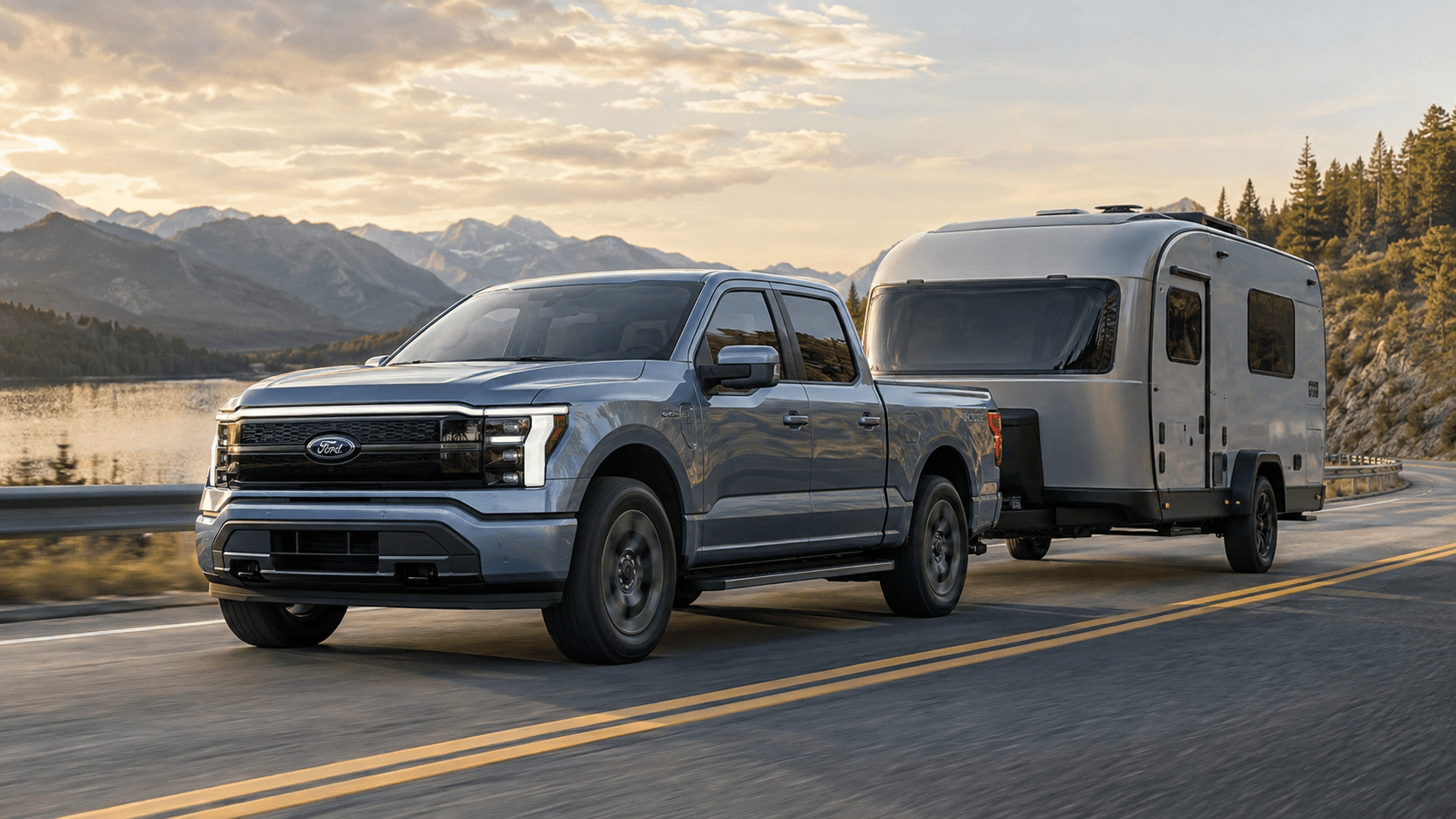
Ford still hasn't published an official towing capacity for the Ford Fathom.
But we already know enough about the truck to make a reasonable estimate.
Based on its size, positioning, Ford's new EV architecture, current Ford truck ratings and what the company has said about its priorities for the Universal EV Platform, our current estimate is that the Ford Fathom will tow around 4,000 to 5,000 pounds when properly equipped.
And if Ford offers a dedicated towing package, we think 5,000 pounds is a very realistic target.
That would put the Fathom above the basic utility expected from a compact lifestyle truck, without trying to turn an affordable EV into an electric Ranger.
What Ford has actually confirmed
Let's separate confirmed information from speculation.
Ford has officially described the Fathom as a four-door midsize electric pickup built on its new Universal EV Platform. The standard-range version starts at $28,350 before destination and other fees, with pre-orders scheduled to begin in early 2027.
Ford has also confirmed LFP battery technology for the new platform, bidirectional power capability, a frunk and bed, five-passenger seating, and a strong emphasis on reducing weight and battery requirements through efficiency.
One thing Ford has not announced yet is towing capacity.
So the numbers below are our estimate, not a leaked or official specification.
Start with Ford's existing trucks
There are two useful reference points.
The 2026 Ford Maverick is rated to tow 2,000 lb standard and up to 4,000 lb with the available 4K Tow Package. Its maximum payload is 1,500 lb.
The larger body-on-frame Ford Ranger can tow 7,500 lb when properly equipped.
At the other end of Ford's EV lineup, the much larger F-150 Lightning can reach 10,000 lb, but it uses a far larger vehicle, battery, cooling system and chassis designed around full-size-truck loads.
That gives us a useful scale:
| Ford truck | Maximum towing |
|---|---|
| Maverick | 4,000 lb |
| Fathom — FathomMods estimate | 4,000–5,000 lb |
| Ranger | 7,500 lb |
| F-150 Lightning | Up to 10,000 lb |
The Fathom is called a midsize pickup, but we don't think that automatically means Ranger-level towing. Its mission is very different.
Why we don't expect 7,500 pounds
Ford has repeatedly emphasized efficiency in the development of the Universal EV Platform.
The company says engineers worked to reduce vehicle weight, improve aerodynamics and reduce the amount of battery required to achieve useful range. Ford has even said the new truck is projected to have roughly a 30% aerodynamic-efficiency improvement at highway speeds compared with a 2025 Maverick and 2022 Hyundai Santa Cruz.
That's important.
Building a truck to tow 7,500 pounds isn't simply a matter of installing an electric motor with enough torque.
You also need suspension capacity, structural strength, brakes, tires, hitch hardware, thermal management and enough cooling to sustain high power output while climbing a grade with thousands of pounds behind the vehicle.
All of those things can add weight and cost. And weight and cost are exactly what Ford's new EV program has been aggressively trying to remove.
For a truck starting at $28,350, chasing a huge headline towing number would work against much of the engineering philosophy behind the vehicle.
Our estimate: 4,000 to 5,000 pounds
Our current prediction looks something like this:
- Base truck: roughly 2,000–3,500 lb
- Properly equipped Fathom: roughly 4,000 lb
- Possible Tow Package: as much as 5,000 lb
If we had to choose one maximum number today, we'd put our money on 5,000 pounds.
Four thousand pounds is already achievable in the Maverick, and Ford is positioning the Fathom as a newer, highly optimized electric pickup rather than simply an EV equivalent of the cheapest Maverick.
At the same time, moving much beyond 5,000 lb begins pushing the vehicle toward Ranger territory, where cooling, braking and chassis requirements become substantially more demanding.
Five thousand pounds therefore looks like a very interesting sweet spot.
It would let owners tow many small and midsize campers, utility trailers, motorcycles, ATVs, jet skis and smaller boats without forcing Ford to engineer the entire truck around heavy towing.
Electric motors aren't the limiting factor
This is one of the more interesting parts.
We don't expect the electric motor itself to be the problem.
Ford previously said its new electric pickup is targeting acceleration comparable to a Mustang EcoBoost. The current Mustang EcoBoost makes 315 horsepower, although Ford has not disclosed the Fathom's actual horsepower or torque figures.
Electric motors also produce strong torque from very low speeds. Getting a loaded trailer moving should therefore be relatively easy.
The harder problem is sustaining that load.
Pull a heavy trailer uphill at highway speed in Texas summer heat and the battery, inverter and motor can remain under high load for minutes at a time. That's where thermal management matters more than a flashy peak horsepower number.
This is also why we think a future Fathom towing package could involve more than just a hitch. Ford's Maverick 4K Tow Package, for example, adds equipment including an upgraded cooling fan and trailer brake controller.
We would not be surprised to see Ford take a similar approach with the Fathom.
The bigger question may be towing range
A Fathom capable of pulling 5,000 pounds would be impressive. But towing capacity and towing range are two very different numbers.
At highway speed, trailer aerodynamics matter enormously.
A relatively streamlined boat trailer might produce a manageable efficiency penalty. A tall travel trailer can dramatically increase aerodynamic drag, regardless of whether it weighs 3,000 or 5,000 pounds.
That means the Fathom could technically be capable of towing a fairly substantial camper while experiencing a major reduction in highway range.
Until Ford announces the battery size and EPA range, putting an exact towing-range figure on the Fathom would be premature.
But here's a useful theoretical example.
If a future Fathom managed around 3.5 mi/kWh in normal highway driving and a tall trailer reduced efficiency to roughly 1.8–2.2 mi/kWh, energy consumption would nearly double.
A truck capable of around 250 miles in normal driving could therefore end up closer to roughly 130–160 highway miles while towing a large aerodynamic trailer.
That is not a Fathom prediction yet. It's simply an example of how EV towing math works. Trailer shape, speed, elevation, weather and payload can change that number dramatically.
What could a 5,000-lb Fathom actually tow?
A 5,000-pound maximum rating would cover a surprisingly large portion of recreational towing.
It could potentially handle things such as a small travel trailer, teardrop camper, lightweight fishing boat, personal watercraft trailer, ATV or motorcycle trailer, small utility trailer, and many compact pop-up campers.
Of course, the trailer's loaded weight matters, not its advertised empty weight.
Payload will matter too.
Trailer tongue weight normally counts against the truck's payload capacity. Add four passengers, luggage and several hundred pounds of tongue weight and payload can become the limiting factor before the trailer reaches the vehicle's theoretical maximum towing rating.
That's why the eventual Fathom payload specification may be nearly as important as its towing number.
Our prediction
Until Ford publishes the specifications, nobody outside the program can give a definitive Fathom towing capacity.
But the engineering clues are beginning to create a fairly clear picture.
Fathom doesn't appear to be designed as an electric Ranger replacement. It looks more like an efficient, inexpensive electric truck that still needs enough capability to genuinely function as a truck.
FathomMods forecast: approximately 4,000–5,000 lb maximum towing capacity, with 5,000 lb being our current best estimate for a properly equipped version.
Could Ford surprise us with 6,000 pounds or more? Absolutely.
But we think Ford would rather deliver useful real-world towing without adding the battery, cooling capacity, chassis weight and cost required to chase a class-leading number.
And for the kind of buyer the Fathom appears to be targeting, 5,000 pounds may be more than enough.
As soon as Ford releases the official towing, payload, battery and range specifications, we'll update this analysis and see how close our estimate was.